

The Burden of Non-Communicable Diseases in India
By Merlyn Paul
Non-Communicable Diseases (NCDs) were for long considered the “burden” of what many may consider the developed world. Often chronic, lasting for three months or longer and typically worsening over time; NCDs result from a combination of genetic, physiological, environmental and behavioural factors. While they can be controlled, they are rarely cured and require long-term care, medication, and sometimes hospitalisation (WHO 2025).
For the past decade or so, data shows a substantial increase of NCDs in the low and middle income (LMIC) countries around the world, particularly in highly populated countries. Globally in 2021, 18 million people died from an NCD before age 70 years; 82% of these premature deaths occur in LMIC countries. In India, the increase of NCDs can be attributed to several factors, including rapid urbanisation, shifts in dietary habits, sedentary lifestyles, and the aging of the population.(Sharma, Gaidhane, & Choudhari, 2024)
NCDs including chronic illnesses such as heart disease, diabetes, and cancer, have become the leading cause of mortality in India, accounting for 63% of total deaths. 55.4% of Disability-Adjusted Life Years (DALYs) have been reported related to NCDS in 2016, up from 30.5% in 1990 (Prabhakaran et al., 2018).
This gradual epidemiological emergence of NCDs and injuries alongside communicable diseases such as maternal, neonatal, tuberculosis and related diseases has substantial macro and microeconomic effects, increasing the economic burden on both households and the nation.
The microeconomic effects on households can be understood by the distribution of Total Health Expenditure (THE) of India which is estimated to be 3.16% of GDP (Rs 5.96 lakh crores). Out of which, the Government Health Expenditure (GHE) accounts for 40.61% of THE, while 48.21% is met by Out-Of-Pocket Expenditure (OOPE) by households. OOPE also accounts for 53.32% of current health expenditure (Thomas, Dash, and Sahu 2023) (National health accounts, 2018-19). Alarmingly, 12.4 % of households fell below the poverty line due to OOPE in 2017-18 (Nanda and Sharma 2023).
At the national level, the economic impact occurs through productivity losses due to premature mortality, early labour force exits, absenteeism, and work at lowered capacity. Economic growth model estimates that chronic diseases like heart disease, stroke, and diabetes cost India an estimated $17 billion (Rs. 1.41 Lakh Crore approx.) in lost GDP between 2006 and 2015 by reducing the labour force, savings, and productivity (Bloom et al. 2011). Moreover, every 10% increase in NCD mortality reduces India’s GDP growth by 0.5% annually (Abegunde et al. 2007).
NCD care is financially demanding, as it requires continuous treatments, multiple outpatient appointments, and regular medication. On average, NCD-affected households spend ₹35,512 on healthcare services, significantly higher than the ₹21,214 spent by non-NCD households. OOPE is higher for outpatient care compared with hospitalisation in NCD households.
Among those hospitalised, the average hospitalisation costs incurred by NCD households is substantially more than incurred by non-NCD households, driven largely by medical expenses, particularly medicines and diagnostics.
Those hospitalised in public facilities, NCD households incur an OOPE of more than twice the amount spent by non-NCD households and in private facilities, OOPE is higher as well. NCDs lead to higher OOPE across variables such as - age, household size, caste, water access, medical facility type, exacerbated at the intersection of such factors.
However, several studies in public health financing emphasise the importance of including catastrophic health expenditure (CHE) as a key indicator to identify the complex nature of the financially vulnerable population, as for some groups, even moderate health spending can push households into financial distress.
Groups at highest risk of CHE include those near the poverty line, SC/ST communities, elderly- or female-headed households, smaller households, people with disabilities, informal workers among others (Behera and Pradhan 2021) (Nanda and Sharma 2023).
Additionally, health insurance reach is low in India, covering only 15.5% of individuals. A combination of low health insurance coverage and a dominant presence of the fee-for-service private health sector has forced Indian households to rely on out-of-pocket health expenditure (OOPE) as a means of financing healthcare.This economic burden, however, varies across the disease groups and care levels In India. In India, government schemes largely focus on reducing the expenditure on inpatient care alone, this leaves people with NCDs dependent on outpatient care resort to hardship financing practices like informal borrowing or selling of assets in the event of health shocks. (Thomas et al. 2023)
The lack of alignment between insurance coverage and actual spending patterns reveals a market failure in insurance as well. While outpatient care accounts for higher OOPE for NCD patients, most insurance plans focus only on hospitalisation exacerbating financial vulnerability.
This brings to the fore two key tenets of Universal Health Coverage (UHC) as envisioned by National Health Policy 2017 being challenged by the growing weight of OOPE and CHE: first, all populations, rich or poor, should have access to affordable and necessary health care services (equity viewpoint) second, the people shouldn't be at risk of financial hardship (financial risk protection) due to the high and constant expense of health care by incurring cost disproportionate to their household income (Behera and Pradhan 2021).
With the growing incidences of NCDs, it becomes imperative that, in addition to prioritizing health promotion and disease prevention, the burden of OOPE on NCD households is critically addressed through a re-evaluation of existing healthcare policies, with focus on sustainable healthcare financing solutions.
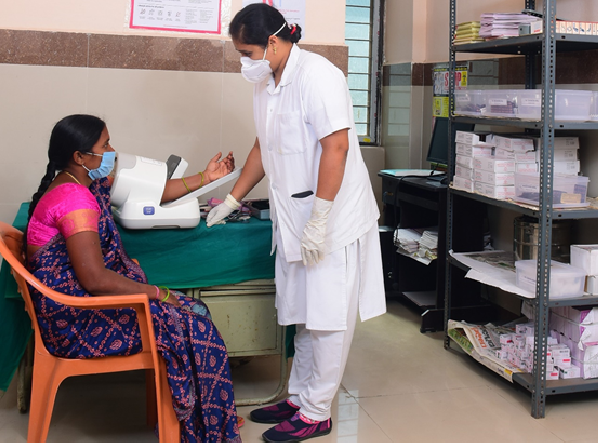
A woman being screened for hypertension in a Health and Wellness Centre (HWC) in Warangal District in the State of Telangana (Credit: Dr. Satyendra via WHO.int)
References:
Abegunde, Dele O., Colin D. Mathers, Taghreed Adam, Monica Ortegon, and Kathleen Strong. 2007. The Burden and Costs of Chronic Diseases in Low-Income and Middle-Income Countries. The Lancet 370 (9603): 1929–38. https://doi.org/10.1016/S0140-6736(07)61696-1
Behera, Sasmita, and Jalandhar Pradhan. 2021. "Uneven Economic Burden of Non-Communicable Diseases among Indian Households: A Comparative Analysis." Edited by Petri Böckerman. PLOS ONE 16 (12): e0260628. https://doi.org/10.1371/journal.pone.0260628.
Bloom, D.E., Cafiero, E.T., Jané-Llopis, E., et al. 2011. The Global Economic Burden of Non-Communicable Diseases. Geneva: World Economic Forum.
Nanda, Mehak, and Rajesh Sharma. 2023. "A Comprehensive Examination of the Economic Impact of Out-of-Pocket Health Expenditures in India." Health Policy and Planning 38 (8): 926–38. https://doi.org/10.1093/heapol/czad050.
Prabhakaran, D., et al. 2018. "Non-Communicable Diseases in India: A Comprehensive Review." The Lancet Global Health.
Thomas, Arya Rachel, Umakant Dash, and Santosh Kumar Sahu. 2023. "Illnesses and Hardship Financing in India: An Evaluation of Inpatient and Outpatient Cases, 2014–18." BMC Public Health 23 (1): 204. https://doi.org/10.1186/s12889-023-15062-7.
Sharma, Mayank, Abhay Gaidhane, and Sonali G. Choudhari. 2024. A Comprehensive Review on Trends and Patterns of Non-communicable Disease Risk Factors in India. Cureus 16 (3): e57027. https://doi.org/10.7759/cureus.57027
Merlyn Paul is a graduate of the Post Graduate Programme in Public Policy (8th cohort) at the Takshashila Institution. Views are personal and do not represent Takshashila’s policy recommendations.